
Key takeaways:
Marketing project managers juggle an extraordinary number of responsibilities—from coordinating creative teams and managing client expectations to tracking budgets and hitting campaign deadlines. With so many competing priorities, mastering time management tips for marketing project managers isn't just helpful; it's the difference between thriving and merely surviving. Consider this: the average worker spends 51% of their workday on tasks that add little to no value. For marketing PMs handling multiple accounts and campaign timelines, that statistic should be a wake-up call. This article delivers 10 essential time management tips for marketing project managers, backed by data and designed to help you reclaim your most valuable resource—your time.
The Current Challenge: Why Marketing PMs Are Losing the Time Battle
Campaign cycles are shorter, client expectations are higher, and the volume of channels demanding attention has exploded. It's no surprise that over 58% of marketers report feeling overwhelmed in the past 12 months, with half experiencing emotional exhaustion.
One major culprit? Meetings. Research shows that managers spend an average of 13 hours per week in meetings, and 67% of those meetings are deemed unproductive. Meanwhile, a Chartered Institute of Marketing survey found that 56% of marketers are concerned about burnout in their current roles. Burnout doesn't just affect well-being—it drives turnover, reduces quality, and damages client relationships.
These challenges underscore why effective time management strategies are more critical than ever. With the right approach and project management tools, you can take back control of your schedule and your team's productivity.
The Strategic Framework: A Smarter Approach to Managing Your Time
Before diving into specific tactics, it's worth adopting a strategic mindset. The best time management approaches aren't about squeezing more work into fewer hours—they're about working with greater intentionality, focusing energy on high-impact activities while eliminating or delegating the rest.
This requires a shift from reactive to proactive management. Instead of spending your day responding to urgent requests and putting out fires, the goal is to build systems that prevent fires in the first place. The framework below organizes the 10 tips into three categories: prioritization and planning, execution and efficiency, and measurement and improvement.
Tip 1: Master Task Prioritization with the Eisenhower Matrix
Not all tasks are created equal, yet many marketing PMs treat their to-do lists as if every item carries the same weight. The Eisenhower Matrix—a framework that categorizes tasks by urgency and importance—offers a powerful antidote.
Research from the UK-based Development Academy found that the Eisenhower Matrix is the most successful time management technique, with 100% of users reporting their work felt under control four to five days per week. By contrast, people who simply dealt with whatever came up felt in control far less often.
For marketing PMs, this means separating genuine emergencies (a client's urgent revision before a live date) from tasks that feel urgent but aren't truly important (responding to every Slack message immediately). Make it a daily habit to sort your tasks into the four quadrants: do now, schedule for later, delegate, or eliminate entirely.
Tip 2: Conduct a Weekly Planning Session
A disciplined 30-minute weekly planning session can save you hours of reactive scrambling. Use this time to review ongoing projects, assess upcoming deadlines, flag potential bottlenecks, and align with team leads on priorities for the week ahead.
Tracking weekly KPIs is a practice that top marketing project managers rely on to maintain visibility into project health. By reviewing metrics like task completion rates, budget burn, and resource utilization each week, you catch small problems before they become big ones. This kind of proactive oversight is one of the most valuable time management tips for marketing project managers because it reduces the time you spend in crisis mode later.
Schedule your planning session at a consistent time—Friday afternoons or Monday mornings work well—and protect that block as non-negotiable.
Tip 3: Ruthlessly Audit Your Meeting Schedule
Given that the average professional loses significant hours to unproductive meetings each week, conducting a meeting audit is one of the quickest wins available to any PM. Start by reviewing your calendar for the past two weeks and asking three questions about every recurring meeting: Does it have a clear purpose? Does it require my attendance? Could the outcome be achieved asynchronously?
Implement "meeting hygiene" rules for your team: every meeting requires an agenda shared in advance, a designated facilitator, and documented action items afterward. Block at least two hours of "deep work" time on your calendar each day where meetings cannot be scheduled. Encourage asynchronous communication—recorded video updates, project management tool comments, or brief written summaries—for status updates that don't require real-time discussion.
Tip 4: Automate Repetitive Tasks
One of the most impactful time management tips for marketing project managers is to identify and automate recurring, low-value tasks. Marketing automation can save teams six or more hours per week on routine activities like social media scheduling, email campaigns, and reporting.
The principle extends beyond marketing-specific automation. Within your project management workflows, look for repetitive actions that can be automated: task assignments triggered by project phase changes, automated deadline reminders, status report generation, and client notification emails. Research indicates that 91% of marketers say automation directly improves their productivity, and project managers who embrace it consistently report having more time for strategic work.
Start by listing every task you perform more than twice a week. For each one, ask: can this be automated, templatized, or delegated? Even partial automation—like using templates for client status emails—can reclaim meaningful time.
Tip 5: Centralize Communication and Eliminate Tool Sprawl
Switching between email, Slack, text messages, multiple Google Docs, and spreadsheets doesn't just waste time—it fragments your attention and creates information silos. Every context switch costs you mental energy and makes it harder to maintain the big-picture view that effective project management requires.
The solution is to centralize your team's communication and project data in a single platform. When task discussions, file sharing, status updates, and client communication all live in one place, you eliminate the need to hunt for information across multiple tools. This is particularly valuable for workflow optimization strategies that agencies rely on to save significant hours each week.
Set clear team norms about which channel to use for what: project-specific discussions go in your project management tool, quick coordination happens in chat, and email is reserved for client-facing communication. Stick to these norms consistently and new team members will onboard faster, too.
Tip 6: Build and Maintain Process Templates
Every hour spent reinventing a project plan, creative brief, or kickoff deck is an hour that could be spent on higher-value work. Standardized templates for your most common project types eliminate this waste and create consistency across your team.
For marketing agencies, this might include templates for campaign launch plans, content calendars, social media briefs, client onboarding checklists, and post-mortem reports. These are among the tools and frameworks that actually work for marketing agency project management—not because they're flashy, but because they reduce decision fatigue and minimize errors.
Store your templates in your project management platform so they're easily accessible and can be deployed with a few clicks. Review and update them quarterly based on team feedback. The upfront investment in creating good templates pays dividends on every project that follows.
Tip 7: Use Time Tracking to Identify Hidden Time Drains
You can't improve what you don't measure. Time tracking gives you and your team visibility into where hours are actually going—and the results are often surprising. Many PMs discover that internal meetings, unclear briefs, and excessive revision cycles consume far more time than estimated.
Review time logs weekly, looking for patterns. Are certain project types consistently taking longer than scoped? Is one team member overloaded while another has capacity? These insights allow you to make data-driven adjustments to processes, staffing, and client expectations.
Make time tracking frictionless by choosing a tool that integrates with your project management platform. Frame it as a team improvement tool, not a surveillance mechanism.
Tip 8: Forecast Resources and Plan Capacity Proactively
Nothing derails a marketing project manager's week faster than discovering that a critical team member is overbooked, on vacation, or pulled onto another project. Proactive resource planning prevents these surprises and is one of the most important time management tips for marketing project managers who oversee multiple concurrent projects.
Use resource forecasting to visualize workloads across your team by person and by project. Account for planned time off, holidays, and non-project commitments. When you spot an emerging bottleneck—say, your designer is at 120% capacity next week—redistribute work early, before deadlines are at risk.
This proactive approach also improves your ability to scope new work accurately. When a prospective client asks for a rush project, you can quickly assess whether you have the capacity to deliver without overwhelming your existing team. That clarity protects both your team's well-being and your client relationships.
Tip 9: Build Buffer Time Into Every Project Timeline
Marketing campaigns rarely unfold exactly as planned. Creative revisions take longer than expected, clients need extra review time, and unexpected technical issues arise. Yet many PMs build timelines with zero margin for error.
Set internal deadlines that are at least two to three business days ahead of client-facing deadlines. Include explicit time blocks for review cycles, stakeholder feedback, and quality assurance. This isn't padding—it's acknowledging the reality of how creative work gets done.
Buffer time also gives you a negotiation tool. When a client asks, "Can we add one more deliverable?" you can assess whether your buffer can absorb the addition or whether a timeline extension is needed.
Tip 10: Conduct Quarterly Workflow Audits
The final and perhaps most overlooked time management practice is continuous improvement. What worked for your team six months ago may no longer be optimal. Client needs evolve, team composition changes, and new tools become available.
Schedule a quarterly workflow audit with your team. Ask three questions: What's working well that we should keep doing? What's slowing us down that we should change? What should we stop doing entirely? Use these sessions to refine processes, update templates, and identify new automation opportunities.
Top-performing agencies treat project management as an evolving discipline, not a static set of processes. They measure outcomes, collect feedback, and iterate. This commitment to continuous improvement compounds over time—each quarter, your team becomes a little more efficient, a little more aligned, and a lot less likely to burn out.
Measuring Success: KPIs That Reflect Better Time Management
How do you know if your improvements are working? Track these key metrics:
On-time delivery rate measures the percentage of projects completed by their original deadline. A rising on-time rate signals that your planning and execution are improving.
Utilization rate tracks how much of your team's time is spent on billable or productive work versus administrative overhead. Most agencies aim for 70–80%.
Scope change frequency measures how often project scopes expand after kickoff. Frequent scope creep suggests initial planning or client communication needs attention.
Team satisfaction captures whether your people feel their workloads are manageable. Given that over 55% of U.S. workers report burnout, this metric matters for both retention and work quality.
Review these KPIs monthly and connect improvements directly to the time management practices you've implemented.
Future Considerations: Where Time Management Is Heading
The landscape of project management is evolving quickly. AI-powered tools are beginning to automate scheduling, resource allocation, and even aspects of client communication. PM software now saves employees an average of 498 hours annually, and that number will only grow as AI capabilities mature.
For marketing project managers, staying ahead means adopting integrated platforms that combine project management, time tracking, resource planning, billing, CRM, and client portals in a single ecosystem. When all of these functions connect, you eliminate data silos and the manual reconciliation that eats up time.
How Ravetree Helps Marketing Project Managers Master Time Management
Ravetree is built for the challenges marketing project managers face every day. As an all-in-one work management platform, it brings project management, resource planning, time and expense tracking, billing, and client communication together under one roof—so you spend less time switching between disconnected tools and more time driving results.
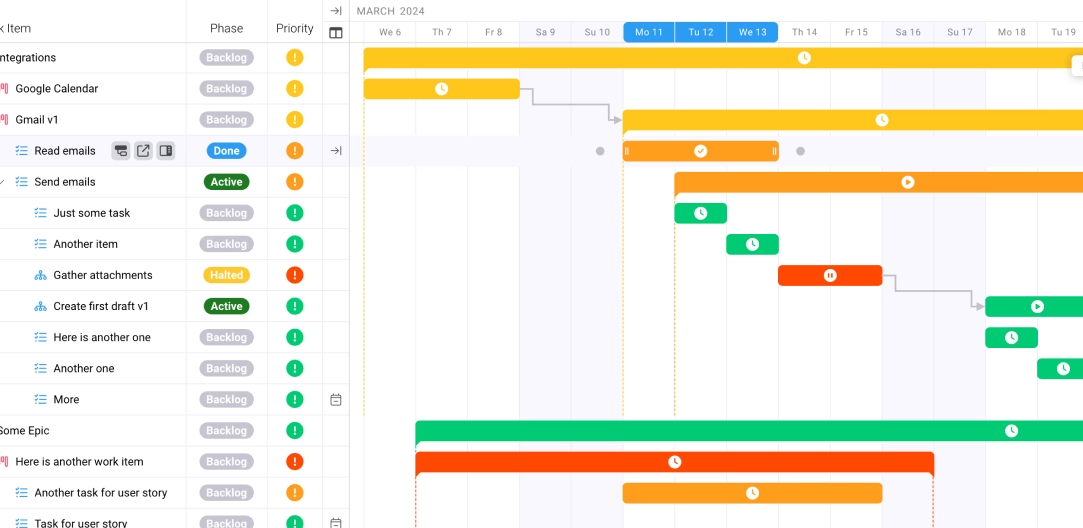
With Ravetree, you can build reusable project templates, track time directly within tasks, forecast team capacity with visual resource planning tools, and share real-time project status with clients through dedicated client portals. For marketing PMs serious about reclaiming their time, Ravetree provides the operational backbone that makes it possible.
Conclusion
Effective time management tips for marketing project managers come down to a consistent theme: work with intention, not just intensity. From mastering prioritization frameworks like the Eisenhower Matrix to automating repetitive workflows, building buffer into timelines, and conducting regular process audits, each tip in this article is designed to help you focus your energy where it matters most.
The data is clear—professionals who adopt structured time management practices report greater control over their workloads, lower stress, and better outcomes. By implementing these 10 essential time management tips for marketing project managers, you can transform how you lead campaigns, manage teams, and deliver results for your clients. Start with one or two changes this week, measure the impact, and build from there. Your future self—and your team—will thank you.
Frequently Asked Questions
What is the single most impactful time management tip for marketing project managers?
Conducting a weekly planning session is often the highest-leverage change you can make. It shifts your mindset from reactive to proactive, helps you identify bottlenecks early, and ensures your team is aligned on priorities before the week begins.
How can marketing project managers reduce time spent in meetings?
Start by auditing your recurring meetings and eliminating those without clear outcomes. Require agendas for every meeting, set strict time limits, and encourage asynchronous updates for routine status check-ins.
What tools help marketing PMs manage their time more effectively?
All-in-one work management platforms like Ravetree combine project management, time tracking, resource planning, and client communication in a single tool, reducing context switching and eliminating data silos.
How often should marketing project managers audit their workflows?
Quarterly audits strike the right balance between allowing new processes to take hold and catching inefficiencies before they become entrenched.
How does automation improve time management for marketing PMs?
Automation handles repetitive, low-value tasks like sending reminders, generating status reports, and routing approvals—freeing up hours each week for strategic thinking and creative oversight.