
Key takeaways:
How the decisions you never made became the business you're stuck running.
You didn't write "do a little bit of everything for anyone who'll pay" on your business plan.
But if you're five or eight years into running an agency, there's a decent chance your service list reads like a restaurant menu, and your client roster spans six industries you never intended to serve.
You didn't choose this. It just happened.
And that's the problem.
How Drift Works
I coach agency owners for a living, and the pattern is almost always the same. Their first few clients came from referrals. A friend needs a website. Their friend needs social media management. Someone asks if you also do paid ads, and you say yes because you need the revenue.
Each "yes" feels small and makes sense in the moment. But over time, those yeses compound into something you never designed. You wake up running an agency that does branding, web development, content marketing, paid media, SEO, email, and "strategy" for law firms, e-commerce brands, healthcare companies, and a local restaurant chain.
I call this Drift. It's what happens when an agency grows without making intentional decisions about who it serves, what it offers, and what it says no to.
Drift isn't dramatic. There's no single moment where things go wrong. It's more like gaining weight over the holidays. A few pounds at a time, until your pants don't fit and you're not sure when it happened.
What Drift Actually Looks Like Inside Your Agency
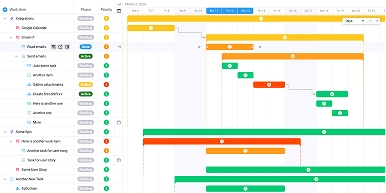
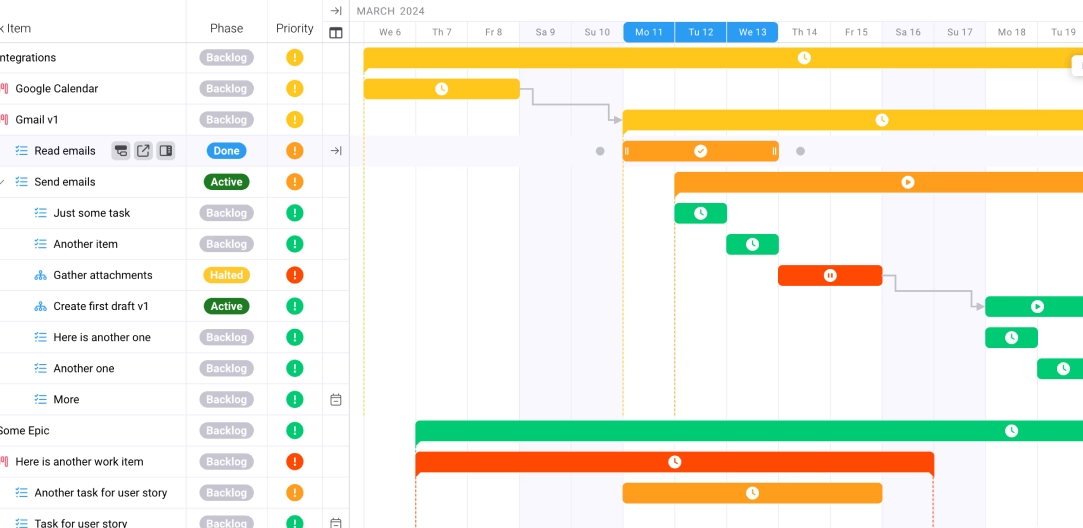
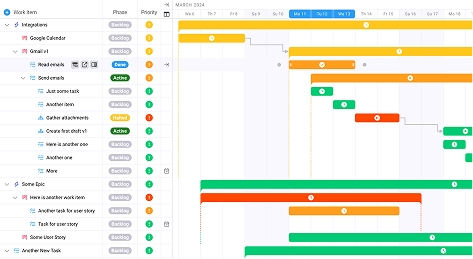
If you're using a project management tool like Ravetree, Drift is easy to spot. Just look at your active projects.
How many of them follow the same process? How many use the same templates? If you pulled up your project list right now, would you see a repeatable pattern, or would every single project look like it was scoped from scratch?
That's Drift showing up in your backlog.
Scoping takes forever. When every client gets something different, every proposal is a custom document. Your team spends hours writing scopes that could take 30 minutes if you'd done this type of work before. Multiply that across 40 or 50 proposals a year, and you're burning serious time before any revenue hits the door.
Your team can't specialize. You hired a designer who's now also doing front-end development and writing ad copy. Your strategist is splitting time between an e-commerce brand and a B2B SaaS company with completely different needs. Nobody gets deep at anything because the work is too scattered.
Margins shrink on every project. Custom work is expensive to deliver. The learning curve on unfamiliar industries eats into your margins. You're constantly context-switching between verticals, which means more mistakes, more revisions, and more time that never makes it onto an invoice.
You can't build systems. This one's subtle, but it's the ceiling. Agencies that do the same type of work repeatedly can build SOPs, templates, and repeatable delivery processes. When you're set up inside Ravetree with standardized project templates, task dependencies, and time estimates based on actual historical data, you can forecast accurately and deliver consistently.
But when every project is a snowflake? You can't templatize chaos. So you end up with a team that's winging it on every engagement, and a project management tool that's more filing cabinet than operating system.
The Growth Ceiling Is Made of Drift
Most agency owners hit a wall somewhere between $1M and $3M in revenue. They assume it's a hiring problem, or an operations problem, or a sales problem.
It's usually a positioning problem wearing an operations costume.
You can't hire specialists when the work requires generalists. You can't build efficient delivery when every project is different. You can't raise prices when you're competing against other agencies who do "a little bit of everything" too. And you can't get referrals for a specific thing when your own clients aren't quite sure what you do best.
The agency owner looks at all of this and thinks, "I need better systems." So they invest in tools, set up project management software, create Slack channels, buy time tracking apps.
And the tools help, to a point. A platform like Ravetree gives you real visibility into where your time is going, which projects are profitable, and where resources are stretched thin. That's valuable. But it also reveals the underlying problem: when you look at the data and see that profitability varies wildly from project to project, that utilization is uneven, that some clients take twice the hours you estimated while others are smooth, you're looking at the cost of never deciding who you're for.
The tools show you the symptoms. The fix is upstream.
Intention Is the Opposite of Drift
The agencies I work with that break through that ceiling all share one thing: they made a decision.
Usually a hard one.
They picked a specific type of company with a specific problem, built an offer around that problem, and said no to work that didn't fit, even when the revenue was tempting.
And then everything got easier.
Scoping got faster because they'd done this type of project dozens of times. They could duplicate a proven project template, adjust the specifics, and have a realistic scope in an hour instead of a day. Their time estimates were accurate because they were based on pattern recognition, not guesswork. Hiring got simpler because they knew exactly what skills they needed. Training got shorter because new team members could learn one type of work deeply instead of skimming across five.
Sales got easier because prospects could immediately understand what the agency did and why it mattered to them specifically. Instead of "we're a full-service digital agency" (which means nothing), they could say something like "we help SaaS companies reduce churn through better onboarding experiences." That's a sentence a prospect can repeat to their boss.
And their project management tools finally started working the way they're supposed to. Resource planning becomes a real advantage when you can predict how long projects take, because you've done similar work 30 or 40 times before. Financial reporting tells a clear story when your service mix is consistent. Capacity planning actually works when your team isn't being pulled in six directions.
The tool doesn't change. The clarity of the business underneath it changes everything.
"But I'll Lose Revenue If I Narrow Down"
This is the fear that keeps most agency owners drifting. And it makes sense on the surface. If you say no to web development clients, that's revenue walking out the door.
But here's what actually happens when agencies narrow their focus: they close fewer deals at higher prices, deliver faster because the work is familiar, get more referrals because clients can describe what they do in one sentence, and stop competing on price because they're no longer interchangeable with every other agency in town.
The math almost always works out. You lose some top-line revenue in the short term and gain margin, predictability, and a business that doesn't depend on your personal involvement in every single project.
I've watched agencies go from $1.5M with 15% margins to $2M with 35% margins within 18 months of making this shift. Less revenue would've been fine. More revenue with better margins is what actually happened.
How to Start Reversing the Drift
You don't need to rebrand overnight. But you do need to start making intentional decisions instead of reacting to whatever walks through the door.
Look at your data first. If you're running projects through Ravetree, pull your profitability reports by client and project type. Which engagements made money? Which ones burned hours you didn't bill? Which clients were easy to work with, and which ones required constant hand-holding? The pattern will be obvious once you look for it. Your best work, your most profitable work, and your smoothest projects almost always cluster around a specific type of client or problem.
Identify your "best client" profile. Not your biggest client. Your best one. The one where the work is good, the team enjoys it, the margins are healthy, and the results speak for themselves. What industry are they in? What size company? What problem did you solve? That's your signal.
Start saying "not yet" before you say "no." You don't have to turn away every piece of misfit work tomorrow. But you can stop marketing those services. You can stop leading with them in proposals. You can gradually shift your pipeline toward the work you actually want, while letting the rest run its course.
Build one repeatable offer. Take that "best client" profile and design a productized service or a standardized engagement around their specific problem. Scope it. Price it. Build the project template in your PM tool so your team can execute it consistently. One repeatable offer is worth more than ten custom ones.
Let your systems reflect the decision. Once you know what you do and who you do it for, your project management setup should mirror that clarity. Your templates, your task structures, your resource allocation, your time categories: all of it should reinforce the work you've chosen to do.
Nothing by Accident
The agencies that grow past the ceiling, the ones that become genuinely fun to run and financially healthy, aren't the ones with the most tools or the biggest teams. They're the ones that made a decision about what they wanted to build and then built everything around that decision.
Your project management platform, your hiring plan, your pricing model, your sales process: none of it works well until the positioning question is answered. And that question isn't "what do we do?" It's "what did we choose to do, and for whom?"
If your answer is "well, it just kind of happened," you haven't answered it yet.
The good news is that the data to make that decision is probably already sitting in your project management tool. Your best clients, your most profitable work, your smoothest deliveries are all in there. You just have to be willing to look at the pattern and commit to it.
The drift stops when you make one decision and mean it.
---
Chris DuBois is the founder of Dynamic Agency OS and host of the Agency Forward podcast. He coaches agency owners on positioning, offer design, and building agencies that grow with intention instead of accident.